Imagined Romes by Benson C. David;
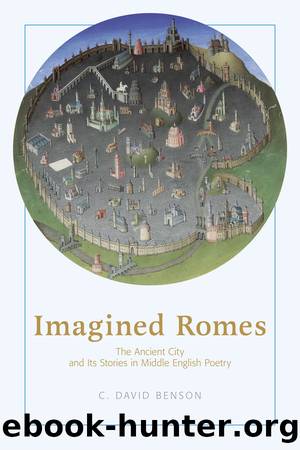
Author:Benson, C. David;
Language: eng
Format: epub
Publisher: Pennsylvania State University Press
The Debate About Trajanâs Salvation
Critical discussion of Trajan in Piers Plowman has not focused on his Romanness, or even much on his relationship with his fellow Roman, Gregory, but rather on the theological justification for his release from hell. As early as 1924, R. W. Chambers insisted that Langland used Trajan to challenge conventional medieval church doctrine that good works alone are insufficient to secure salvation.24 Others disagreed with Chambers, among them T. P. Dunning and later Britton J. Harwood, who both argued that Trajanâs salvation is not exceptional but fully in accord with standard Catholic teaching.25 In one of the most original treatments of the whole question, âThe Trouble with Trajan,â Frank Grady divides the critics who write about Trajanâs salvation, perhaps a little too neatly, into those who see it as âorthodoxâ and those who see it as âheterodox,â and he quotes Robert Adams as predicting that âthis debate is likely to continue.â26 Adams himself had earlier attempted to transcend and reframe the debate by citing Trajanâs salvation as an example of Langlandâs semi-Pelagianism, the belief, which Adams says most theologians held by the thirteenth century, that good works were meritorious, even for nonbelievers.27 Adams argues that Langland âbelieved fervently in manâs obligation to do his very best (facere quod in se est) and in its guaranteed complement, divine acceptation.â As proof of this, he offers Trajanâs insistence that he was freed from hell on account of his righteous deeds, rather than as a result of intercessory masses or prayers: âNo episode in the poem marks Langland more clearly as a semi-Pelagian than this one.â Adams also points out that although Trajanâs good works were not enough to keep him out of hell initially, they did attract Pope Gregoryâs subsequent admiration; thus his works, though not sufficient alone to achieve salvation, âwere, in some sense, a cause of the mercy granted him.â28 Many subsequent discussions of Trajan, such as those by John Burrow, James Simpson, and Emily Steiner, accept, at least in general, Langlandâs semi-Pelagianism, although a substantial attack on that conclusion has been made by Alastair Minnis.29
It is understandable that modern academic opinion should differ about the nature of Trajanâs salvation, because ideas about it were not fixed in the Middle Ages. Langlandâs source, the Legenda aurea, concludes its account of Trajan with an extensive survey of different views of the emperorâs fate, as noted above.30 It reports that some say that Trajan was restored to life so that he could become a Christian and receive grace; others, that his punishment was only temporarily suspended; others, that he was sent to hell with the knowledge that Pope Gregory would eventually pray for his release; and still others, that even if Gregory did not actually pray for him, God often grants unexpressed wishes, though in any case Trajan was only granted relief from infernal pain, not heaven itself. Two starkly opposed views about Trajanâs salvation in the popular English universal history the Polychronicon indicate the range of late medieval opinion on the issue.
Download
This site does not store any files on its server. We only index and link to content provided by other sites. Please contact the content providers to delete copyright contents if any and email us, we'll remove relevant links or contents immediately.
The Universe of Us by Lang Leav(15184)
The Sun and Her Flowers by Rupi Kaur(14628)
Adultolescence by Gabbie Hanna(9019)
Whiskey Words & a Shovel II by r.h. Sin(8089)
Love Her Wild by Atticus(7833)
Smoke & Mirrors by Michael Faudet(6288)
Wiseguy by Nicholas Pileggi(5925)
The Princess Saves Herself in This One by Amanda Lovelace(5040)
Love & Misadventure by Lang Leav(4917)
Memories by Lang Leav(4902)
Milk and Honey by Rupi Kaur(4834)
Bluets by Maggie Nelson(4682)
Too Much and Not the Mood by Durga Chew-Bose(4454)
Pillow Thoughts by Courtney Peppernell(4396)
Good morning to Goodnight by Eleni Kaur(4295)
The Poetry of Pablo Neruda by Pablo Neruda(4233)
Algedonic by r.h. Sin(4156)
HER II by Pierre Alex Jeanty(3678)
Stuff I've Been Feeling Lately by Alicia Cook(3534)
